
Lalit Modi Reveals He Begged Indian Players to Join 2007 T20 World Cup
Authored by betgiris.xyz, 18/06/2026
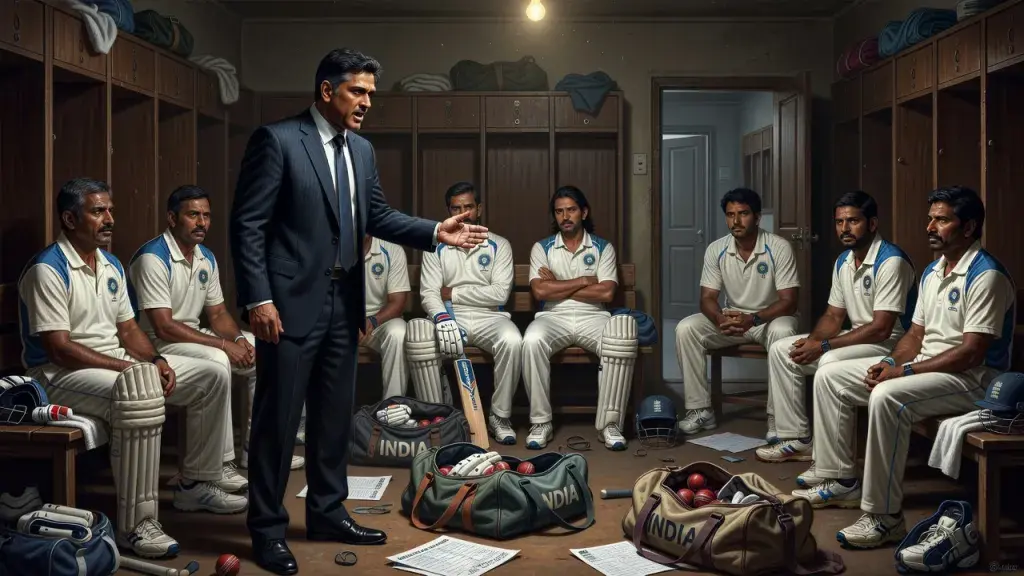
Nearly two decades on from one of cricket's most consequential months, Lalit Modi has offered a candid and revealing account of just how close India came to sleepwalking past the inaugural ICC World Twenty20. In an exclusive interview with ANI, the former IPL chairperson recalled entering the Indian dressing room during their 2007 England tour and personally imploring players - one by one - to commit to a format they openly dismissed as a "stupid game." The story reframes what has long been remembered as a triumphant origin story for T20 cricket in India, and it raises uncomfortable questions about how differently history might have unfolded.
India's tour of England ran from July 19 to September 8, 2007, taking in a three-match Test series and a seven-match ODI series - a gruelling schedule that left senior players physically drained and mentally checked out before the inaugural ICC World Twenty20 was even due to begin on September 11 in South Africa. Modi's account places him physically in that dressing room, navigating a wall of indifference from some of the biggest names in the sport. "I went and I said, 'Please, I beg you to play the T20,'" he recalled. "They said, 'Lalit, are you joking? What is this stupid game? We don't want to play it.'" The responses, he said, were uniform: a long tour, exhaustion, a desire to return to family. It is a far cry from the current climate in which missing a World Cup fixture - never mind an entire tournament - would, in his words, cause "uproar." For context, sports betting markets have since expanded dramatically across formats, from the established to the niche; even disciplines like floorball bets now attract dedicated global interest, a testament to how profoundly the commercial appetite for competitive sport has broadened since 2007.
What made the situation even more striking, Modi explained, was the BCCI's institutional response to the format: rather than send a full-strength side, the board dispatched what he described as a "second team" - raw, relatively inexperienced, and led by a young MS Dhoni. Rahul Dravid, Sachin Tendulkar, and Sourav Ganguly, all present in England, did not travel to South Africa for the tournament. "Completely raw. Completely green," Modi said. By any modern standard, fielding that squad for a World Cup would be inconceivable. The players who did go - Dhoni, Virender Sehwag, Yuvraj Singh, Gautam Gambhir, among others - ultimately delivered one of cricket's most celebrated upsets, winning the title and transforming the global perception of the format overnight.
A Tournament With No Audience - Until Yuvraj Changed Everything
Modi's account of the tournament itself is equally telling. He described the early stages of the 2007 T20 World Cup as a commercial non-event - low viewership, disinterested broadcasters, and advertisers unwilling to commit without proof of an audience. "Nobody believed in T20 cricket in India," he said. "If there are no eyeballs, there's no advertising dollars." The turning point, in his telling, was Yuvraj Singh's extraordinary six sixes off Stuart Broad in a single over during India's Super 8 match against England - a moment that stopped casual viewers mid-channel-change and dragged the tournament into mainstream conversation. Modi claimed he had placed incentives around such moments precisely to engineer this kind of viral impact. "I just said anybody who makes six sixes or takes six wickets in an over, I'll give you a push," he said. Whether or not the outcome was truly "orchestrated" in any meaningful sense, the commercial effect was real and immediate.
The Ripple Effect: From Reluctant Participants to a Global Format
The distance between 2007 and today is difficult to overstate. The ICC Men's T20 World Cup is now among the most-watched sporting events on the planet. The IPL, which Modi launched in 2008 directly off the back of that tournament's success, routinely generates broadcast deals worth billions of dollars and has reshaped franchise cricket globally, spawning equivalent leagues in the Caribbean, South Africa, Australia, and the UAE. India's market, in particular, has become the gravitational centre of world cricket's economy - the very outcome Modi said he was trying to build toward when he went around the world "trying to convince people" of T20's viability. That the format needed convincing at all is now almost impossible to imagine for a generation that has grown up watching T20 as cricket's most accessible and commercially dominant form.
A Reminder That History Is Rarely Inevitable
Modi's recollection carries value beyond nostalgia. It is a reminder that the sporting and commercial structures that now feel permanent were, at a specific moment, fragile and contingent on individual decisions, persuasion, and a measure of fortunate timing. Had India's senior stars refused outright, had Yuvraj's over arrived in front of an empty television audience, had the BCCI doubled down on its scepticism - the trajectory of T20 cricket, and with it the IPL and the entire architecture of modern franchise cricket, could have been meaningfully different. Modi's version of events places himself at the centre of that pivotal moment. His claims are, inevitably, his own. But the broader picture he paints - of institutional reluctance giving way to commercial revolution - is well-supported by how the years since have unfolded.